
Building knowledge graphs from simulation data of crystallographic defects
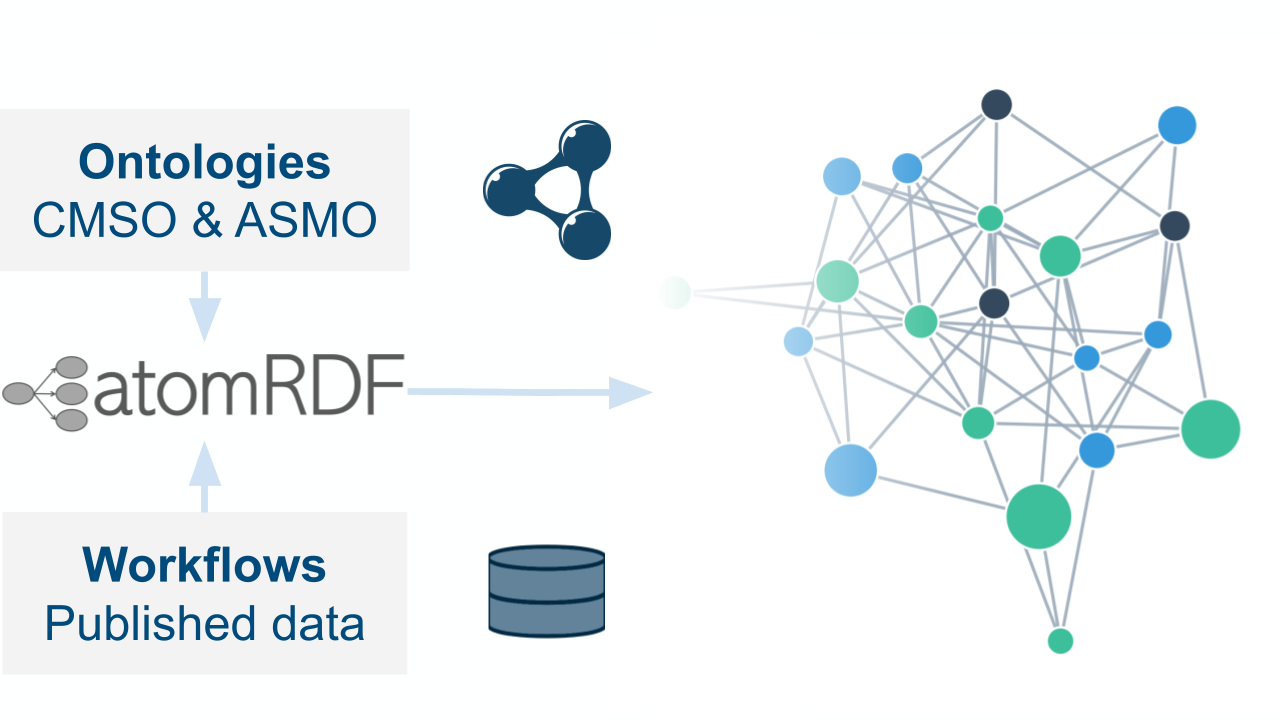
Using ontologies (CMSO and ASMO) with atomRDF to annotate simulation workflows, enabling interoperable knowledge graphs and harmonized crystalline defect data across data resources.
The IUC17 demonstrator illustrates how ontologies and semantic technologies can be embedded into computational workflows to make simulation data FAIR. Crystalline defects such as vacancies, dislocations, and grain boundaries are central to materials science, yet their descriptions differ widely between simulation codes and data repositories. This demonstrator addresses that gap by integrating the Open Crystallographic Defect Ontologies (OCDO) into atomistic workflows.
The demonstrator uses the atomRDF Python package to automatically annotate data from density functional theory (DFT) and molecular dynamics (MD) simulations executed in the pyiron workflow environment. Annotated simulation outputs can also be linked to existing research data resources such as the Materials Project, allowing heterogeneous datasets to be harmonized into a coherent semantic infrastructure.
By enabling standardized semantic description, this demonstrator lays the foundation for cross-domain reuse of crystallographic defect data.
Highlights:
- Jupyter notebooks: Interactive demonstrators showcasing annotation, enrichment, and querying workflows.
- atomRDF: Automated semantic annotation of atomistic simulation outputs.
- OCDO: Standardized ontology framework for crystalline defects across scales. Includes the atomistic simulation and computational sample ontologies (ASMO and CMSO).