
Simulation Workflow for Microstructure Evolution During Cold-Rolling
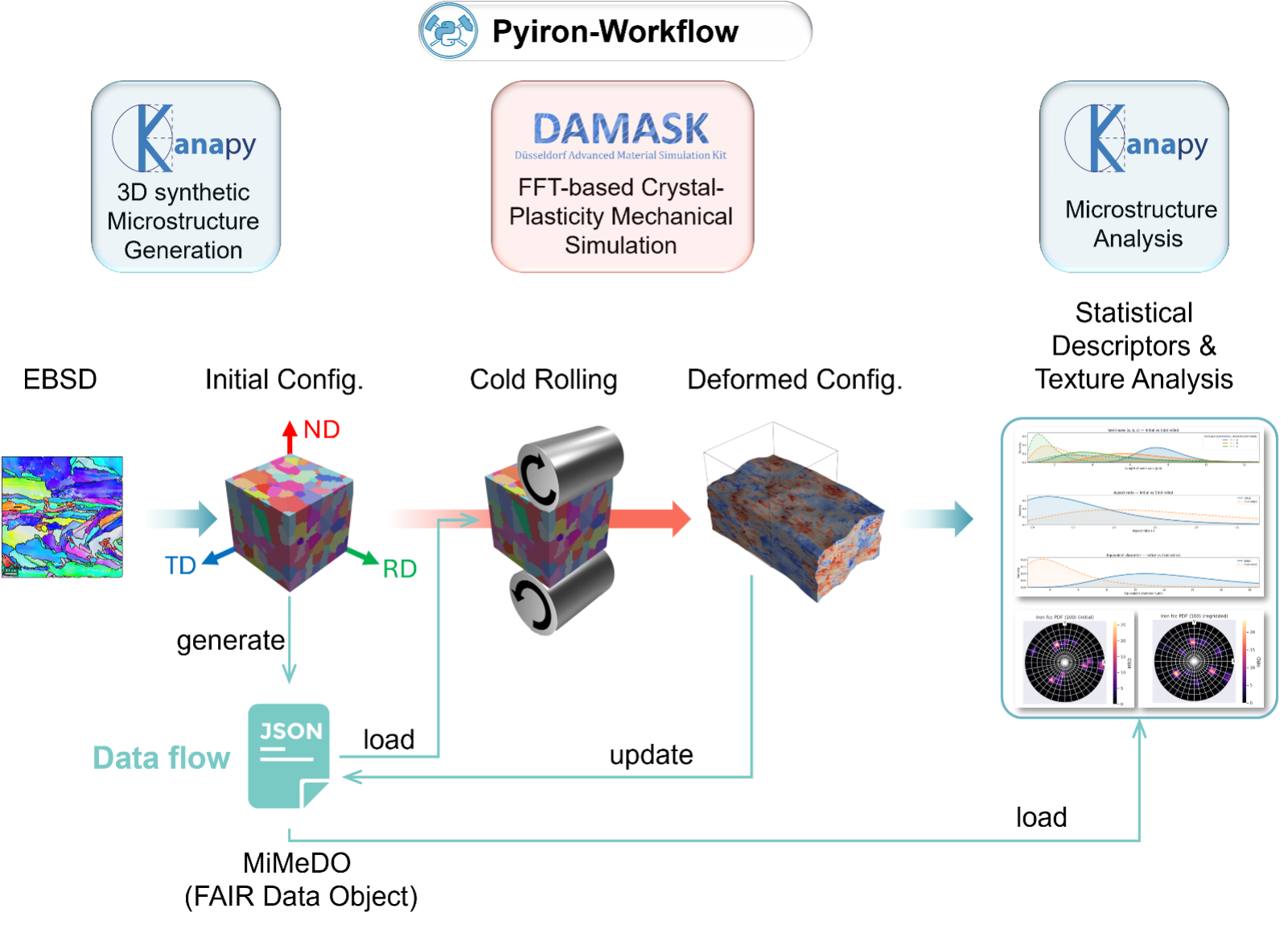
Integrated demonstrator pipeline: Kanapy synthesizes and analyses microstructure, DAMASK computes deformation response, and Pyiron-workflow automates FAIR-MiMeDO updates to capture microstructure evolution over time.
The IUC07 demonstrator targets a key bottleneck in materials simulation: tracking microstructure evolution in form of spatiotemporal microstructure data. 3D data sets containing snapshots of microstructures are generated by many codes but are difficult to exchange and reuse because formats are incompatible. IUC07 therefore develops a code-agnostic infrastructure that represents microstructure evolution and correlated field data (e.g., stress/strain, temperature, etc …) as FAIR Digital Objects which are structured according to the modular microstructure/mechanical performance data (MiMeDat) schema, enabling interoperability across tools, length/time scales, and links to property prediction. Integrated tools:
- Kanapy: generates synthetic 3D microstructures and performs statistical analysis.
- DAMASK: performs FFT-based crystal-plasticity mechanical simulations.
- Pyiron_workflow: constructs workflows as computational graphs.
This demonstrator includes the following steps:
- Read a sample EBSD map and extract microstructure statistical descriptors
- Generate a statistically equivalent 3D microstructure as a FAIR digital object (DO) following the MiMeDat schema.
- Export the structure to DAMASK as a FAIR-MiMeDO object.
- Run a cold-rolling simulation in DAMASK.
- Capture microstructure evolution by updating the FAIR-MiMeDO at selected time steps.
- Re-analyse the evolved microstructure in Kanapy and compare to the initial state.
The demonstrator creates a unified, automated chain from microstructure generation to mechanical simulation and post-processing, while storing results as FAIR-MiMeDOs to ensure reuse, traceability, and long-term preservation. Automated data exchange minimizes manual file handling, and the modular node-based structure keeps the workflow easy to adapt to other simulation tasks.