
Collaborative Determination of Elastic Modulus in Aluminium through Simulation and different Nanoindentation Analysis
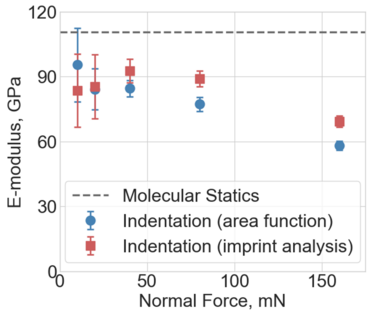
A comparative analysis of the elastic modulus of Al AW1050W was conducted under varying normal forces, utilizing different methodologies: contact area measurement, application of the Oliver-Pharr method, and density functional theory (DFT) simulations.
This MSE Workflow Demonstrator illustrates how digital infrastructures and specialized tools make materials science more reproducible and transparent. It focuses on comparing different methods for determining the elastic modulus of the engineering material Al AW1050W. A comparative analysis was carried out under varying normal forces using two nanoindentation-based approaches - contact area measurement and the Oliver-Pharr method - together with density functional theory (DFT) simulations:
- PASTA-ELN (developed by NFDI-MatWerk) for experimental data management
- pyiron (co-developed by NFDI-MatWerk) for simulation workflows
- Chaldene (co-developed by NFDI-MatWerk) for image processing
All results and metadata are stored in structured repositories and aligned with the MatWerk ontology, ensuring interoperability and reusability. The demonstrator not only enables reliable comparisons of elastic modulus values but also proves the benefits of machine-readable protocols, standardized workflow representations, and automated metadata extraction.Together, these results highlight how connected digital workflows can make collaborative research in materials science more efficient, reproducible, and sustainable.