
Motivation
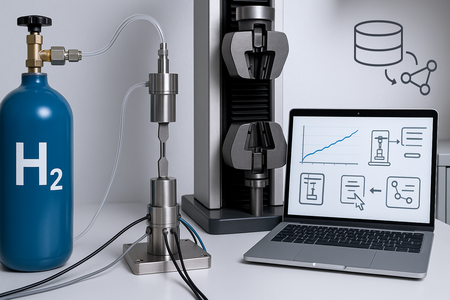
Hydrogen plays a key role in future energy and mobility systems, but its interaction with structural materials remains a major challenge. Reliable data and standardized testing procedures are essential for safe and sustainable use of hydrogen technologies. By developing reusable workflows, semantic data descriptions, and a shared infrastructure for round-robin tests, this project creates lasting value for the MatWerk community. Strong industrial participation ensures that the solutions are directly aligned with technological needs, while integration with other NFDI initiatives fosters interoperability and long-term impact. The IUC addresses the challenge of systematically capturing, semantically describing, and FAIRly providing data on the effects of hydrogen on metallic materials. It focuses on the semantic description of devices, measurement procedures, and sample history-including hydrogen charging and transportation-as well as the development of workflows and databases for data storage, sharing, and reuse.
Overview
| Main requirements: - Semantic description of the relevant devices, measurement procedures and metadata - Semantic description of the sample history, incl. H charging and sample transportation - Database to share and store data, as well as Workflows |
| Main Task Area: TA-WLE Other related Task Areas: TA-SAI, TA-MDI |
| Possible connections within NFDI: NFDI4ING |
| Material/Data: Metallic alloys, e.g., advanced high-strength steels, Ni-based alloys, Al alloys, used for structural applications and exposed to corrosive environment containing in particular hydrogen. Data is obtained from mechanical testing and thermal desorption spectroscopy. |
| Main Success Scenario: - Semantic description of the relevant devices, measurement procedures and metadata - Semantic description of the sample history, incl. H charging and sample transportation - Database to share and store data, as well as Workflows |
| Added value for the MatWerk community: The IUC results into a reusable procedure and toolset to perform Round Robin test for materials characterization. |
Goals
- Establish standardized and reusable workflows for testing the effects of hydrogen on metallic materials.
- Develop semantic descriptions for devices, measurement procedures, and sample histories-including hydrogen charging and transport.
- Implement FAIR-compliant databases and workflows to enable efficient data storage, sharing, and reuse.
- Create sustainable value for the MatWerk community through shared infrastructure and coordinated round-robin testing.
- Ensure strong industrial participation so that solutions are directly aligned with technological needs.
- Integrate with other NFDI initiatives to foster interoperability and achieve long-term impact.
All Infrastructure Use Cases
- IUC01 Teaching framework for MSE research data infrastructure
- IUC02 Development and application of a framework for distribution of reference datasets
- IUC03 Storage concepts for large hierarchical datasets - merged into IUC15
- IUC04 Model driven data space exploration
- IUC05 Digital infrastructure and workflows for labs - merged into IUC15
- IUC06 Integrating materials data from experiments and computation (ICME) into Industry 4.0 manufacturing paradigms - transferred to the NFDI Section ‘Industry Engagement’
- IUC07 Beyond 3D: tools for tracking spatiotemporal microstructure evolution
- IUC08 Approaches and best-practise examples for implementing the digital transformation in the daily laboratory work
- IUC09 Infrastructure interfaces with condensed matter physics (collaboration with FAIRmat)
- IUC10 Interoperability of workflow systems
- IUC11 Development of coupled ontologies and workflows for thermochemical treatments
- IUC12 Alignment of application- and higher-level ontologies
- IUC13 Co-creation environment for linked data resources
- IUC14 Integrated data infrastructure for accelerated materials development
- IUC15 Multiscale materials tomography
- IUC16 Unified ontology for matrix-inclusion microstructure and composites – deactivated
- IUC17 Ontologies for defects in crystals
- IUC18 Machine learning for data-driven material modelling and inverse design
- IUC19 Round-robin tests for materials characterization
- IUC20 Standardized description of samples for electron microscopy