
Overview
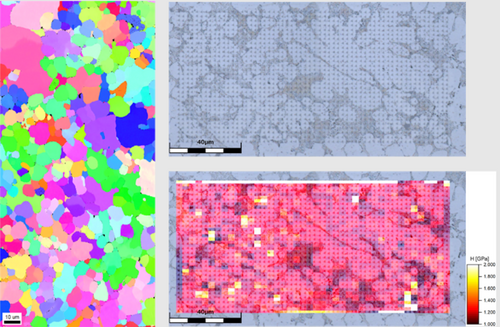
The Working Group “Metadata in Nanoindentation and Micromechanics” focuses on advancing the understanding of microstructure–property relationships in metals, ceramics, and polymers through small-scale mechanical testing. Techniques such as nanoindentation, microcompression, and in situ experiments (e.g., SEM/TEM-based) allow precise probing of elastic, plastic, and fracture behavior at the micro- and nanoscale. By integrating microstructural characterization-such as EBSD, TEM, or APT-with high-throughput mechanical testing, we aim to establish robust correlations between local structure and mechanical response. The group brings together experts working with diverse materials and instrumentation to develop standardized metadata protocols and analysis frameworks that ensure interoperability, reproducibility, and scalability. A particular focus lies in harmonizing data formats and workflows across techniques, enabling efficient data sharing and paving the way for advanced analytics and machine learning approaches in micromechanics.
| Acronym: | NanoData |
| Website: | |
| Contact: | Prof. Dr. Ruth Schwaiger, FZ Jülich GmbH; Prof. Dr.-Ing. Karsten Durst, TU Darmstadt, Prof. Dr.-Ing. Wenwen Song, Universität Kassel, Prof. Dr.-Ing. Benoit Merle, Universität Kassel |
| DFG Classification: | 4.31-03 - Coating and Surface Technology 4.31-04 - Mechanical Properties of Metallic Materials and their Microstructural Origins 4.31-05 - Glass, Ceramics and Derived Composites |
| Material/ Methodology: | Nanoindentation raw data and analysis / Experiments |
| Engagement: | Four scientific research groups will contribute data and analysis input, and implement / test developments of the initiative |
Related Use Cases
All Participant Projects
- PP01 From atoms to turbine blades – a scientific basis for a new generation of single crystal superalloys
- PP02 Structural and chemical atomic complexity
- PP03 Method development for mechanical joinability in versatile process chains
- Project ended - PP04 Magnetoelectric sensors: from composite materials to biomagnetic diagnostics
- PP05 Hysteresis design of magnetic materials for efficient energy conversion
- PP06 Modeling of oxygen-free production
- Project ended - PP07 Processing uncertain microstructural data
- Project ended - PP08 Cluster of Excellence Living, Adaptive and Energy-autonomous Materials Systems
- Project ended - PP09 The Digital Transformation in Materials Testing: Necessary Actions for the Paradigm Change in Enterprises
- Project ended - PP10 Integrated engineering of continuous-discontinuous long fiber reinforced polymer structures
- Project ended - PP11 ERC Starting Grant MuDiLingo: Ontology Design for Dislocations
- PP12 Data Science in MSE education, qualification and life-long learning
- PP13 Correlative Microscopy and Tomography
- PP14 Materials modeling across the scales
- PP15 Metadata in nanoindentation and micromechanics
- PP16 Profile area advanced materials engineering at RPTU
- PP17 Leibniz-Institut für Werkstofforientierte Technologien
- PP18 Bundesanstalt für Materialforschung und -prüfung (BAM)
- Project ended - PP19 Physikalisch-Technische-Bundesanstalt – Standards for reporting numerical information (PTB)
- PP20 Materials-open-Laboratory
- PP21 FAIR Grain Boundaries
- PP22 Engineered Living Materials with Adaptive Functions
- PP23 Multiscale analysis and inverse design of uncertain meso-structures
- PP24 AI-based data collection and optimisation of additive manufacturing process parameters for titanium-based materials
- PP25 Data-driven alloy and microstructure design of sustainable structural metals
- PP26 Atomic-scale understanding and design of multifunctional compositionally complex solid solution surfaces
- PP27 O(A)pportunities for your Publications
- PP28 BioAntiFatigue
- PP29 Applying Interoperable Metadata Standards
- PP30 DGM Expert Committee on hydrogen effects in engineering materials
- PP31 Plattform MaterialDigital