
Overview
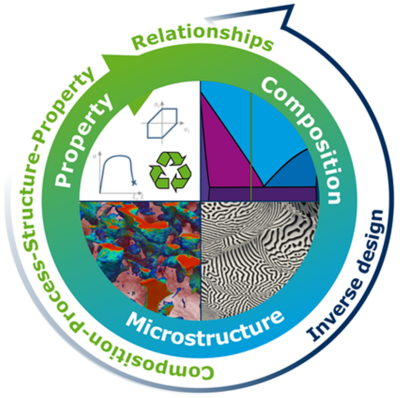
Production and processing of metallic materials currently account for 40% of all industrial greenhouse gas emissions. The extraction of the associated minerals also produces several billion tons of by-products every year, some of which are harmful. It is therefore imperative that future metallic materials become more sustainable. In the Priority Program 2489 DaMic, funded by German Research Foundation (DFG) essential scientific foundations for this development are created and a contribution is made to establish a new field of research at the interface of digitization and sustainability.
The aim of DaMic is to develop digital methods for inverse materials design and to use them to create new, sustainable and recycling-adapted structural metals. Alloys with a reduced number of elements, in particular critical elements, and thus better compatibility, so-called lean alloys, and material systems with a high tolerance to impurities from the use of secondary raw materials in the sense of the science of dirty alloys are of particular relevance for improving recyclability and sustainability. Possible negative effects of the modified alloy compositions are to be minimized through targeted alloy, microstructure and process design so that the resulting properties are comparable with currently available construction materials.
| Acronym: | SPP 2489 |
| Website: | https://tu-dresden.de/ing/forschung/dfg-schwerpunktprogramme/spp-2489/ |
| Contact: | Prof. Dr.-Ing. Markus Kästner, TU Dresden |
| DFG Classification: | 4.31 - Materials Engineering 4.32 - Materials Science 4.12 - Mechanics and Constructive Mechanical Engineering |
| Material/ Methodology: | - Recyclability and sustainability of aluminum and steel alloys - Data-driven methods for inverse materials design enabled digital Process-Structure-Property linkages - High-throughput methods capturing microstructure evolution for property prediction. |
| Engagement: | 9 subprojects à 2 doctoral students |
Related Use Cases
All Participant Projects
- PP01 From atoms to turbine blades – a scientific basis for a new generation of single crystal superalloys
- PP02 Structural and chemical atomic complexity
- PP03 Method development for mechanical joinability in versatile process chains
- Project ended - PP04 Magnetoelectric sensors: from composite materials to biomagnetic diagnostics
- PP05 Hysteresis design of magnetic materials for efficient energy conversion
- PP06 Modeling of oxygen-free production
- Project ended - PP07 Processing uncertain microstructural data
- Project ended - PP08 Cluster of Excellence Living, Adaptive and Energy-autonomous Materials Systems
- Project ended - PP09 The Digital Transformation in Materials Testing: Necessary Actions for the Paradigm Change in Enterprises
- Project ended - PP10 Integrated engineering of continuous-discontinuous long fiber reinforced polymer structures
- Project ended - PP11 ERC Starting Grant MuDiLingo: Ontology Design for Dislocations
- PP12 Data Science in MSE education, qualification and life-long learning
- PP13 Correlative Microscopy and Tomography
- PP14 Materials modeling across the scales
- PP15 Metadata in nanoindentation and micromechanics
- PP16 Profile area advanced materials engineering at RPTU
- PP17 Leibniz-Institut für Werkstofforientierte Technologien
- PP18 Bundesanstalt für Materialforschung und -prüfung (BAM)
- Project ended - PP19 Physikalisch-Technische-Bundesanstalt – Standards for reporting numerical information (PTB)
- PP20 Materials-open-Laboratory
- PP21 FAIR Grain Boundaries
- PP22 Engineered Living Materials with Adaptive Functions
- PP23 Multiscale analysis and inverse design of uncertain meso-structures
- PP24 AI-based data collection and optimisation of additive manufacturing process parameters for titanium-based materials
- PP25 Data-driven alloy and microstructure design of sustainable structural metals
- PP26 Atomic-scale understanding and design of multifunctional compositionally complex solid solution surfaces
- PP27 O(A)pportunities for your Publications
- PP28 BioAntiFatigue
- PP29 Applying Interoperable Metadata Standards
- PP30 DGM Expert Committee on hydrogen effects in engineering materials
- PP31 Plattform MaterialDigital